
⚡️Antibiotics Unlocked : When the wall falls
Welcome to the six-part series "Antibiotics Unlocked," where we will explore the various mechanisms by which antibiotics operate. Grasping how antibiotics function is essential for effective treatments and avoiding antibiotic resistance.
What exactly is antibiotic resistance? Many of us have encountered this term frequently, particularly in clinics or hospitals.
Antibiotic resistance occurs when bacteria adapt to withstand the drugs intended to eliminate them, complicating the treatment of infections. This natural process is accelerated by the overuse and misuse of antibiotics, such as for viral infections and not following prescribed antibiotic regime of dose and duration
Antibiotics work by targeting bacterial components in six different ways:
inhibition of cell wall synthesis
inhibition of protein synthesis (30S ribosome)
inhibition of protein synthesis (50S ribosome)
inhibition of nucleic acid synthesis
inhibition of metabolic pathways
cell membrane disruption
In today's post, we will explore the fundamentals of how an antibiotic functions by inhibiting the synthesis of bacterial cell walls.
⚡️WHEN THE WALL FALLS: inhibition of cell wall synthesis
Target: bacterial cell wall
Effect: weakens the cell wall leading to lysis and ultimately causing death.
The bacterial cell wall consists of a rigid, mesh-like peptidoglycan layer composed of sugars and amino acids. This layer is crucial for giving the cell its structure and strength. Interestingly, human cells lack this peptidoglycan layer, making it an excellent selective target for antibiotics.
Peptidoglycan, as previously mentioned is made up of sugars and and peptide chains (a peptide is a short chain of two or more amino acids linked by peptide bonds). The sugar subunits present are NAG and NAM (N-acetylglucosamine and N-acetylmuramic acid respectively). The peptide chains are responsible for linking the NAM units together.
Of course, some questions that may arise include:
Why do peptide chains connect only to the NAM units?
How are the NAG and NAM units connected to each other?
How does this structure facilitate the effective functioning of antibiotics?
Let's attempt to address each of these questions one step at a time.
Why do peptide chains connect only to the NAM units?
To understand this, let us take a look at the structures of NAM and NAG.
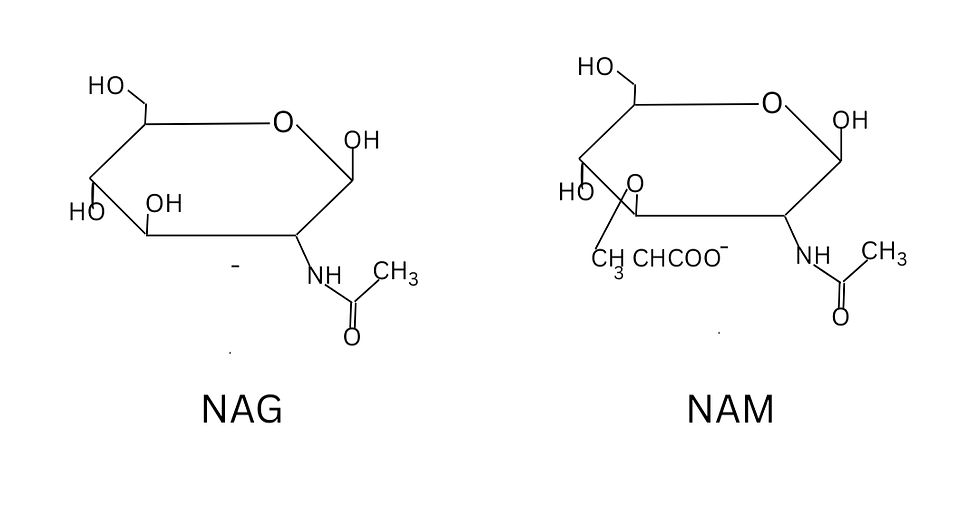
The lactic acid residue associated with the N-acetylmuramic acid (NAM) molecule links it to a peptide chain.
How are the NAG and NAM units connected to each other?
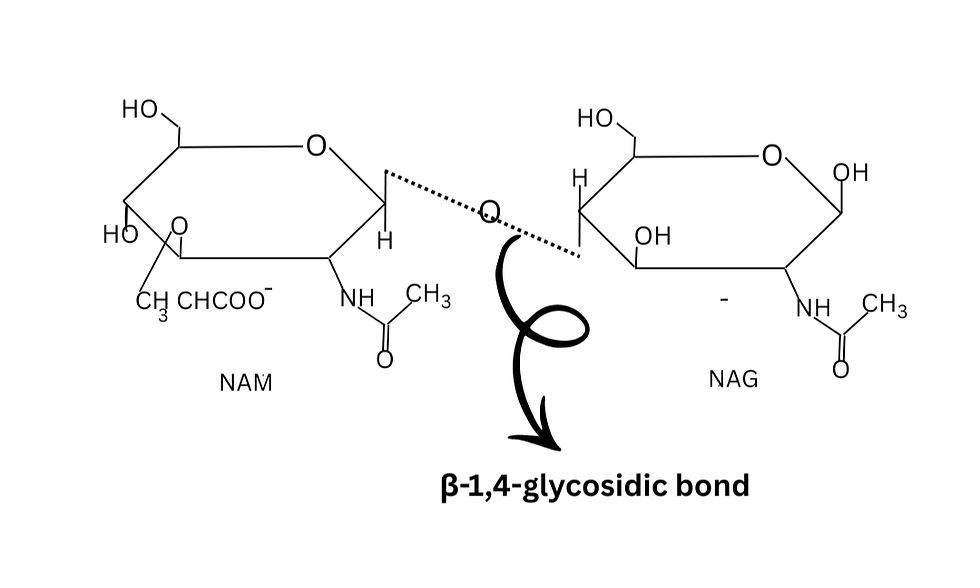
In bacterial cells, NAM and N-acetylglucosamine (NAG) sugar units alternate to form the backbone of the peptidoglycan cell wall, with a short peptide chain branching off from each NAM unit. In simple words, NAM and NAG alternate and are joint by a β-1,4-glycosidic bond to form the backbone of the peptidoglycan layer. The β-1,4-glycosidic bond connects the first carbon of NAM to the fourth carbon of NAG. The enzyme glycosyltransferase facilitates the joining of NAM and NAG.
The image below represents the linking of NAM and NAG by the β-1,4-glycosidic bond.
How does this structure facilitate the effective functioning of antibiotics?
The β-1,4 glycosidic linkage positions the group above the plane of the N-acetylglucosamine ring, giving the chain a straight, extended structure. This arrangement reduces atomic crowding and promotes strong hydrogen bonding between chains, making the peptidoglycan layer rigid and stable.
Interestingly, this same β-1,4 linkage is also a vulnerable point targeted by certain antibiotics. The enzyme lysozyme specifically cleaves this bond — and here’s a fun fact: lysozyme is naturally present in our saliva and tears, serving as part of our body’s built-in defense system.
In summary, antibiotics that disrupt peptidoglycan synthesis weaken the bacterial cell wall, causing it to loose structural integrity and eventually burst (cell lysis) due to osmotic pressure, leading to bacterial death.
Antibiotics: how do they act?
Before starting to understand how the antibiotics work, it is important to know about PBPs, transpeptidases etc.
Penicillin-Binding Proteins (PBPs) are enzymes in the bacterial membrane essential for peptidoglycan synthesis. They include glycosyltransferases, which link sugar units (NAM and NAG) to elongate glycan chains, and transpeptidases, which cross-link peptide side chains, giving the cell wall strength. β-lactam antibiotics bind PBPs, blocking transpeptidation and weakening the wall, leading to bacterial lysis.
β-lactam antibiotics
A class of antibiotics that contain a β-lactam ring in their chemical structure and inhibit bacterial cell wall synthesis by binding to penicillin-binding proteins (PBPs), thereby preventing peptide cross-linking in peptidoglycan and causing bacterial lysis. β‑lactams are a diverse class: some agents are narrow-spectrum while others are broad-spectrum and cover Gram‑positive, Gram‑negative, and anaerobic bacteria
Examples: Penicillins, Cephalosporins
Target: PBPs
Effect: Inhibits formation of peptide cross-links, weakening the cell wall and causing lysis.
Resistance: Bacteria produce β-lactamase, which breaks the antibiotic’s β-lactam ring.
Solution: Combine with a β-lactamase inhibitor
Glycopeptides (vancomycin)
Target: Binds to the D-Ala-D-Ala terminus of NAM pentapeptides in peptidoglycan.
Effect: Blocks transpeptidases (PBPs) from accessing NAM, preventing peptide cross-linking and weakening the cell wall.
Spectrum: Most effective against Gram-positive bacteria, as Gram-negative bacteria have an outer membrane that prevents drug access.
[ Not orally absorbed; usually given intravenously. ]
Other inhibitors
DRUG | TARGET | EFFECT |
| Blocks the transport of NAM and NAG across the cytoplasmic membrane | Inhibits cell wall formation, weakening the wall |
b. Fosfomycin | Inhibits the formation of NAM (by blocking MurA enzyme) | No peptidoglycan precursors produced, stopping wall synthesis |
c. Cycloserine | Inhibits formation of D-Ala-D-Ala dipeptide in the peptide side chain | Prevents peptide cross-linking, producing a weak cell wall |
Bacterial cell walls are like tiny fortresses, and antibiotics are the clever tools that find their weak spots and break them down. By targeting the sugars, peptides, or the enzymes that build them, these drugs make the wall collapse and the bacteria give up. Sure, bacteria can try to fight back, but using antibiotics wisely keeps us ahead. With the right knowledge and care, we can keep these tiny invaders in check and stay healthy and strong!
This is just one way antibiotics work; there's much more to explore. To learn more about antibiotics, continue reading! ✨

Comments